
Worldschooling can give children experiences that are difficult to recreate in a classroom. Travel brings history, geography, language, culture, science and everyday problem-solving into real life, and for many families that freedom is exactly the point.
There are also times when a family wants a little more structure alongside those experiences. A learner may be preparing for GCSEs or IGCSEs, need help with a particular subject, benefit from a consistent academic routine or simply value having one familiar tutor who continues working with them wherever the family happens to be.
That is where online tutoring can be useful. It does not need to replace worldschooling or turn travel into a conventional school timetable. Used well, it can provide continuity, specialist subject support and a reliable educational relationship while leaving space for the flexibility that makes worldschooling work in the first place.
If you are still exploring the wider worldschooling approach, our complete guide to worldschooling covers curriculum choices, exams, routines and the practicalities of learning while travelling. This article focuses specifically on when tutoring may help and what that support can look like in practice.
When tutoring can be useful for a travelling family
Not every worldschooling family needs a tutor. Some learners are progressing well through resources chosen by their parents, online courses or self-directed study and may not need any additional input.
Tutoring becomes more useful when there is a clear reason for introducing it. A learner may be finding one subject increasingly difficult, preparing for a formal qualification, moving between curricula or reaching a stage where parents no longer feel confident supporting the academic content themselves. Another child may understand the material but benefit from having a regular session that gives some structure and accountability.
Sometimes the value is less about addressing a difficulty and more about maintaining continuity. Travel can involve new accommodation, different countries, changing routines and periods where formal learning naturally becomes less structured. A regular tutor can provide one familiar educational relationship that remains consistent even when everything else around the learner is changing.
The important point is that tutoring should meet a genuine need. It should not be added simply because a travelling family feels they ought to recreate school remotely.
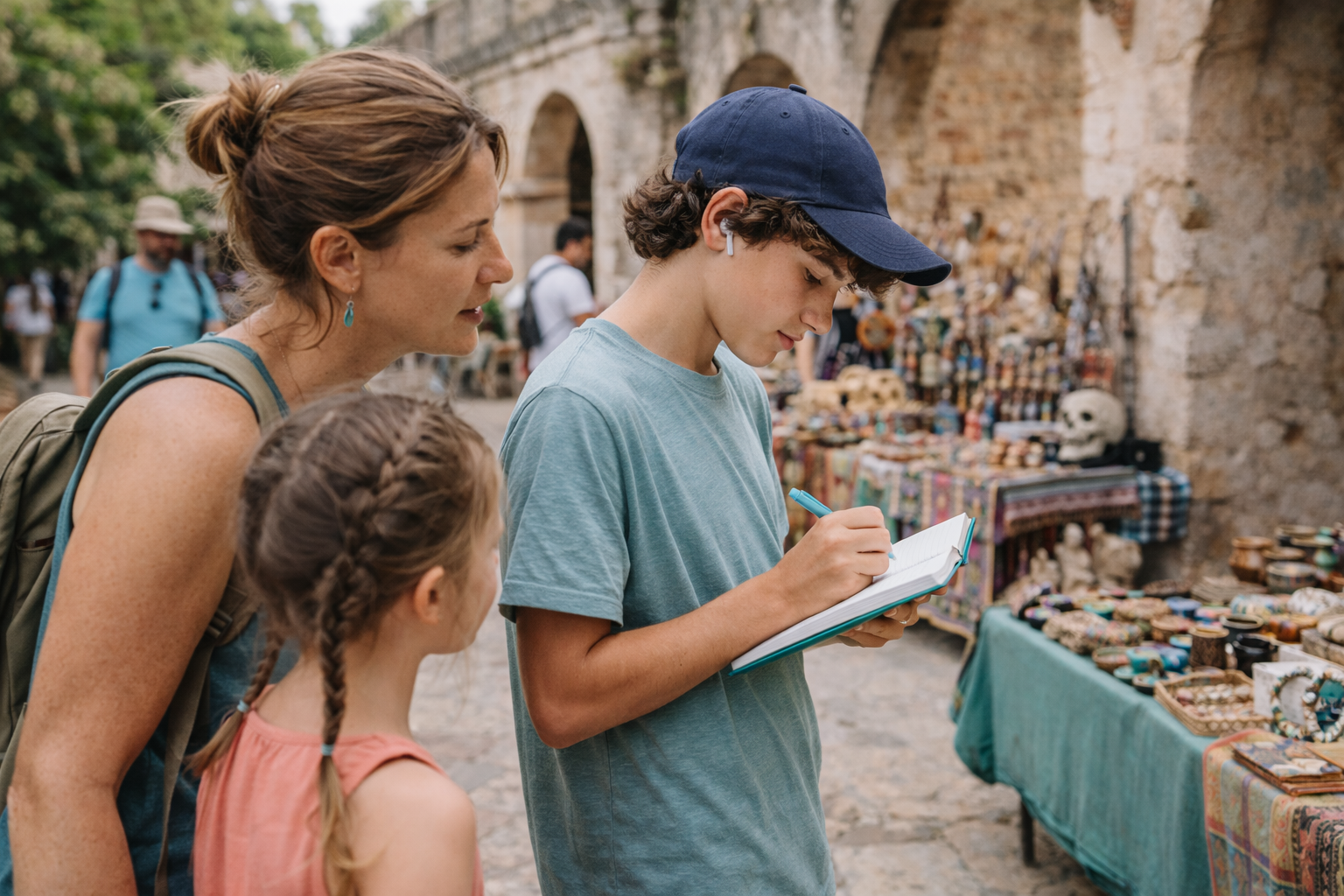
Continuity without losing flexibility
One of the practical challenges of long-term travel is that routines rarely stay completely fixed. A family may spend several weeks in one place, move quickly through another country, take a long-haul flight or deliberately pause formal study while exploring somewhere new.
That flexibility can be a real strength of worldschooling, but some learners still benefit from having a few things that remain predictable. A regular tutoring relationship can provide that anchor. The tutor already knows the learner, what has been covered, which areas are secure and where more support may be needed. The family does not have to start from scratch every time they move.
For learners who value familiarity, this can be particularly helpful. The location may change, but the person on the other side of the screen stays the same.
That does not mean every week has to look identical. Time zones shift, travel days happen and some periods are naturally busier than others. The aim is not rigid scheduling. It is enough consistency to support the learner without making travel feel constrained by the timetable.
Supporting different curricula and exam pathways
Worldschooling families do not all follow the same educational route. Some continue with the English National Curriculum, while others use Cambridge International or Pearson Edexcel qualifications. Some combine online schools, textbooks and educational platforms, while others follow a much more flexible programme shaped by the learner’s interests and future goals.
A tutor working with a travelling family needs to understand that difference. If a learner is following a specific qualification, tutoring should support the correct syllabus and examination requirements. A student preparing for AQA GCSE Maths, for example, has different assessment demands from one studying Cambridge IGCSE Mathematics.
This becomes particularly important as examinations approach. GCSEs and IGCSEs introduce fixed specifications, assessment objectives and examination techniques that are much less flexible than the wider worldschooling lifestyle. A tutor can help identify gaps in knowledge, work through past-paper questions, develop examination technique and make sure revision is directed towards the correct specification.
For younger learners, or families without a fixed curriculum, support may be broader. The focus might be on maintaining core literacy or numeracy, strengthening a particular area or providing more challenge where the learner is progressing quickly.
The approach should follow the learner’s pathway rather than forcing every travelling family into the same programme.
Subject-specific support and confidence
Travel can create rich learning opportunities, but not every subject is equally easy to support through day-to-day experiences.
A learner may absorb a huge amount of Geography through travel and develop strong spoken language skills through conversations abroad, while still finding algebra increasingly difficult. Another may read widely and discuss ideas confidently but need explicit help with essay structure or examination technique.
Parents can also reach a point where subjects become more specialised. Supporting primary Maths is very different from teaching Higher Tier GCSE algebra, and helping a child enjoy Science is different from preparing them for separate Biology, Chemistry and Physics examinations.
This is often where targeted tutoring makes the most sense. The family can continue managing the wider educational experience while a specialist tutor supports a particular subject or skill.
For some learners, confidence is part of that picture too. A student who has been working fairly independently may suddenly meet content that feels much harder. Another may start comparing their progress with friends in school and worry that learning differently means they are less prepared. A consistent tutor can help separate genuine academic gaps from understandable uncertainty.
For children who learn differently, the consistency of one familiar tutor may be particularly useful when travel itself involves frequent changes in environment, routine and sensory demands. The important thing is not to assume every learner needs the same approach, but to adapt pace, communication, resources and session structure around the individual.
What should travelling families look for in a tutor?
A strong subject tutor is not automatically the right tutor for every travelling family.
Experience with the relevant curriculum or qualification matters, particularly for older learners. So does the ability to explain concepts clearly, adapt when the first explanation does not work and understand that not every learner follows a conventional school sequence.
Communication matters too. Families may be coordinating education across several subjects, platforms and providers, so it helps to know what the tutor is working on and what may need attention next.
It is also worth considering whether the tutor genuinely understands the practical realities of travel. Time zones change. Internet connections vary. Families sometimes need to adjust routines around flights, moves or periods of intensive travel. Tutoring should make education feel more manageable, not add another layer of pressure.
Most importantly, the relationship needs to work for the learner. One-to-one support is most useful when the student feels comfortable asking questions, making mistakes and saying when something does not make sense.

How tutoring can work alongside worldschooling
For travelling families, the value of tutoring is rarely limited to the session itself.
A learner may need practice questions, revision tasks, reading or resources they can use independently between sessions. Older students might need work marked or feedback on examination answers. Families may also benefit from knowing which topics should be prioritised next so they can organise wider learning around them.
That does not mean filling every day with homework. Any work between sessions should have a clear purpose and fit realistically around the family’s routine. A younger learner spending several days exploring a new city does not necessarily need a stack of worksheets waiting for them. A student six months away from GCSEs may need a more deliberate independent study routine.
At Plan For Success, we begin by understanding the learner rather than assuming that being a worldschooling family tells us everything we need to know. We look at their current position, educational pathway, goals and the areas where support may be useful.
For some families, that means regular subject tutoring. For others, it may involve examination preparation, short-term support with a particular area or an initial assessment to clarify what would be most useful next. The aim is to provide enough structure and continuity to support progress without trying to remove the flexibility that makes worldschooling work for the family.
Final thoughts
Online tutoring can fit well with worldschooling because it offers something travel itself cannot always provide: consistent access to the same subject specialist wherever the learner happens to be.
Used thoughtfully, it can support examination preparation, strengthen subject knowledge, maintain continuity and give learners a familiar educational relationship alongside the changing experiences of travel.
But tutoring should complement worldschooling, not compete with it. The purpose is not to recreate a school day on a laptop. It is to introduce the right amount of structure, expertise and support where it genuinely benefits the learner.
For some families, that may mean regular weekly tutoring. For others, a short period of targeted support may be enough. The right arrangement depends on the learner, their goals and what the family actually needs at that stage.
About the author
Sophie – Learning Director and Specialist
Sophie is a worldschooling mum to her son and has been worldschooling full-time since August 2023. With a background in education, social care, and children's rights, she is passionate about learning outside of traditional systems and believes education should be flexible, humane, and responsive to the individual child.
At the same time, Sophie recognises that many families remain within formal education systems and need meaningful support due to systemic pressures, gaps, and failures that are no fault of the learner. Her work bridges both worlds, offering flexible, relationship-led tutoring that supports confidence, progress, and autonomy wherever learning takes place.