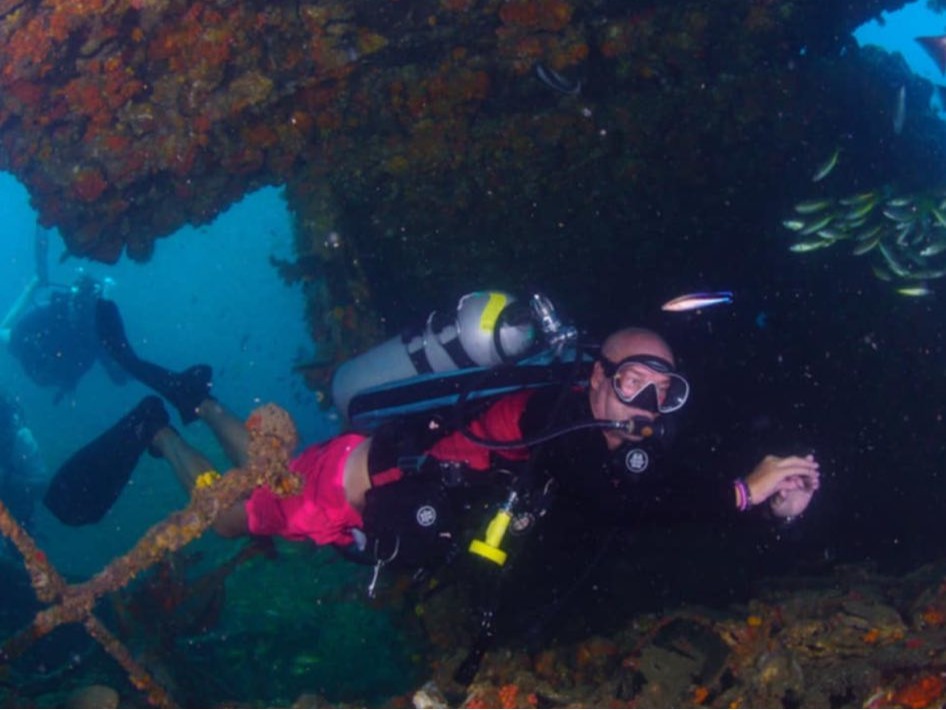
Physics can feel abstract when it is taught only through equations and diagrams. Pressure, density, force and volume may all make sense individually, yet still feel disconnected from anything a learner experiences outside the classroom. Scuba diving changes that very quickly because many of those ideas become visible, measurable and, in some cases, physically noticeable as soon as you enter the water.
I work as both a Maths and Science tutor and a qualified diving instructor, so I often use diving as a way to make difficult ideas more concrete. The point is not that every learner needs to become interested in scuba diving. It is that real situations can give abstract concepts a context. Once a student can picture what is happening, the equation often starts to make much more sense.
Pressure increases as you go deeper
One of the clearest examples is pressure. At the surface, we are already experiencing atmospheric pressure. As a diver descends, the weight of the water above them adds to that pressure. In seawater, the total pressure increases by roughly one atmosphere for every 10 metres of depth, so at about 10 metres a diver is at around 2 atmospheres absolute, and at about 20 metres they are at around 3 atmospheres absolute.
That makes pressure far more than a formula on a page. Divers notice the effect in air spaces such as the ears and mask, which is why equalisation matters during descent. For a learner studying pressure in Physics, this is a useful reminder that the numbers describe something real. It also creates an opportunity to connect the concept with force, area and the wider idea that pressure changes according to the environment.
Boyle’s Law becomes much easier to picture underwater
Boyle’s Law describes the inverse relationship between pressure and volume for a fixed amount of gas at constant temperature. In simple terms, when pressure increases, gas volume decreases. When pressure decreases, gas volume increases. Students often meet that idea first as an equation, but diving provides an immediate physical example because the air spaces associated with a diver are constantly affected by changes in pressure.
As a diver descends, gas is compressed. As they ascend and the surrounding pressure falls, that gas expands again. This is one reason safe diving practice includes breathing continuously and never holding your breath during ascent. The example gives learners something concrete to attach to the relationship between pressure and volume rather than asking them to remember the rule in isolation.
It also helps students see why proportional thinking matters. If pressure approximately doubles from the surface to 10 metres, the volume of a flexible gas space is approximately halved, assuming the conditions for Boyle’s Law are met. That connection between a scientific law and a numerical relationship is where Physics and Maths naturally overlap.
Buoyancy puts forces and density into action
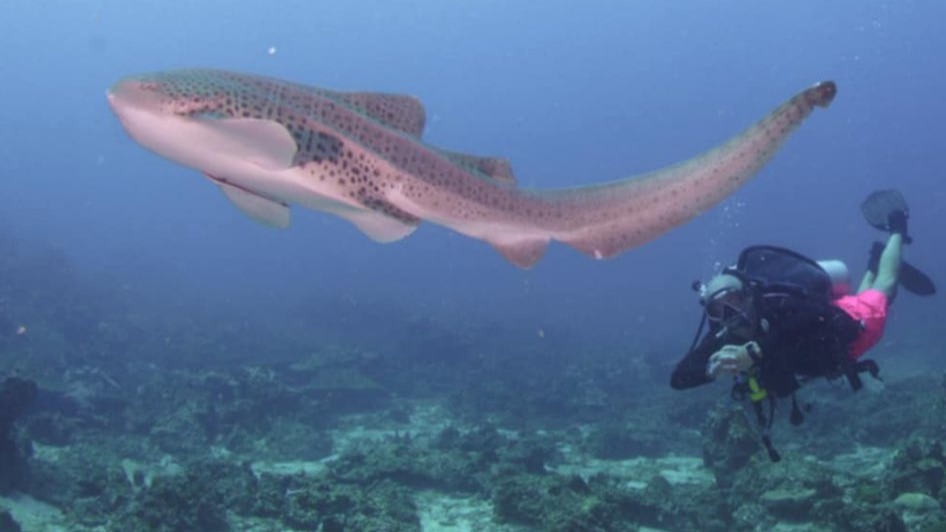
Buoyancy is another concept that can seem much clearer when you can visualise it. A submerged object experiences an upward buoyant force related to the weight of the fluid it displaces. That idea sits behind Archimedes’ Principle and links closely with density, volume and forces.
For a diver, buoyancy is something that has to be managed throughout the dive. Changes in the amount of gas in a buoyancy control device affect overall volume and therefore the balance between upward and downward forces. A diver who is neutrally buoyant is not simply “floating”. The forces are balanced closely enough for them to maintain depth without continually rising or sinking.
This gives learners a practical way to think about resultant force. If the upward and downward forces are balanced, there is no acceleration in the vertical direction. If that balance changes, the diver begins to move. The same underlying ideas appear throughout school Physics, but here they can be seen as part of one connected system rather than a set of separate definitions.
Scuba diving uses proportional reasoning as well as Physics
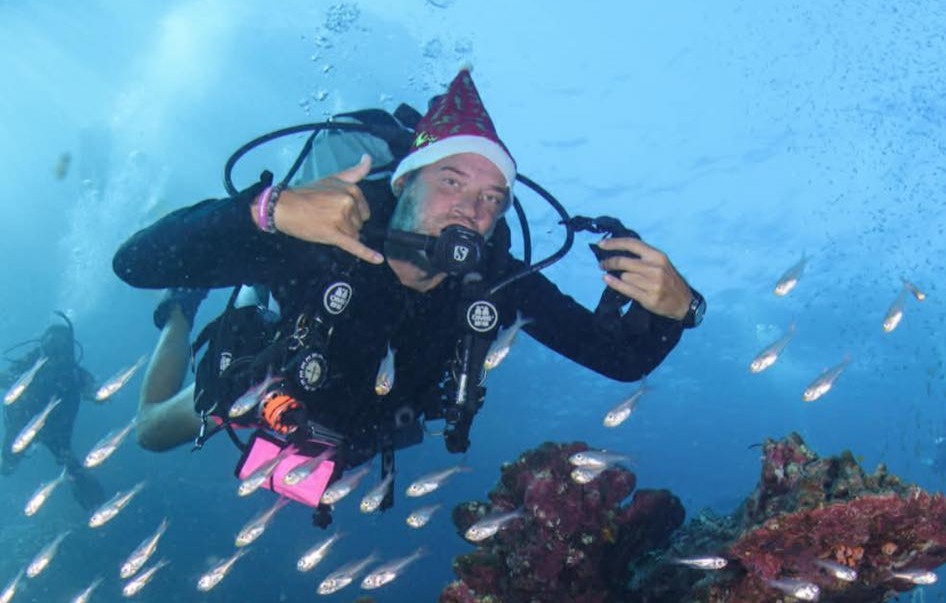
Diving also creates useful examples for Maths because so much of it relies on ratios, rates and proportional reasoning. Gas consumption is a good example. A diver who uses a particular volume of gas per minute at the surface will use gas more quickly at depth because the regulator supplies air at the surrounding pressure. At around 20 metres, where the absolute pressure is roughly three times surface pressure, the same breathing pattern requires roughly three times the surface gas volume from the cylinder.
If a diver’s surface air consumption is 20 litres per minute, a simple model would put consumption at around 60 litres per minute at 20 metres. That immediately creates opportunities to work with multiplication, ratios and unit rates. Similar reasoning appears when divers think about ascent rates, available gas and time at depth.
The useful part educationally is that the calculation has a purpose. The student is not being asked to manipulate numbers simply because a worksheet says so. They can see why the relationship matters, and that often makes proportional reasoning easier to discuss.
Why real-world examples can help difficult ideas make sense
Real-world context does not replace explicit teaching, equations or formal methods. Learners still need to understand the scientific language, use the correct formulae and practise applying knowledge in the way their course or exam requires. What a meaningful example can do is give them a mental model to work from.
A student who has memorised that pressure increases with depth may still struggle with an unfamiliar exam question. A learner who understands why the pressure changes and can picture what happens to gas volume underwater has more to reason with. The context gives the knowledge somewhere to attach, which can make later application more manageable.
This is one aspect of personalised tutoring that matters to me. Different learners connect with different examples. Diving may work brilliantly for one student, while another might understand the same idea more easily through cycling, gaming, cooking, aviation or something else entirely. The aim is not to force one favourite example onto everyone. It is to find a way into the concept that makes sense to the learner in front of you.
Real-world learning is particularly useful when education is flexible
These connections can be especially valuable for home educated learners and travelling families because learning does not have to stay neatly separated from everyday life. A visit to a reef, a dive centre, a science museum or even a conversation about why ears need equalising can lead naturally into Physics and Maths. That does not mean every experience has to become a lesson, but it does mean useful learning opportunities can emerge from the world around the learner.
For families using a worldschooling approach, our complete guide to worldschooling looks more broadly at how travel, formal learning, qualifications and everyday experiences can fit together. Diving is simply one example of how a real environment can make scientific ideas more visible.
How I use this approach in tutoring sessions
In Maths and Science tutoring, I use real examples when they genuinely help clarify an idea. That might mean connecting pressure to diving, linking ratios to gas use, using practical situations to explain forces or finding another context that fits the learner’s interests. The academic goal still comes first. If a student is preparing for GCSE or A Level, they also need to understand the correct terminology, equations, units and examination requirements.
The value of the real-world example is that it can make the formal content easier to access. Once the student understands what is happening, we can move back into the specification and apply that understanding to exam-style questions, calculations and explanations. The context supports the learning rather than replacing it.
Final thoughts
Scuba diving is full of Physics and Maths. Pressure changes with depth, gas volume responds to changes in pressure, buoyancy depends on forces and displaced water, and gas planning relies on proportional reasoning. None of those ideas exist only underwater, but diving makes them unusually easy to see working together.
For learners, that is the wider lesson. Maths and Science become more meaningful when they are connected to something real enough to picture, question and investigate. Sometimes the difference between memorising an idea and understanding it is simply finding the example that finally makes it click.
About the author
Mike – Maths, Science and Computer Science Specialist at Plan for Success
Mike specialises in Maths, Science and Computer Science, supporting learners from primary through to A Level. A qualified diving instructor with a passion for Marine Science, Mike brings real-world examples into every session to help students build genuine understanding and confidence.