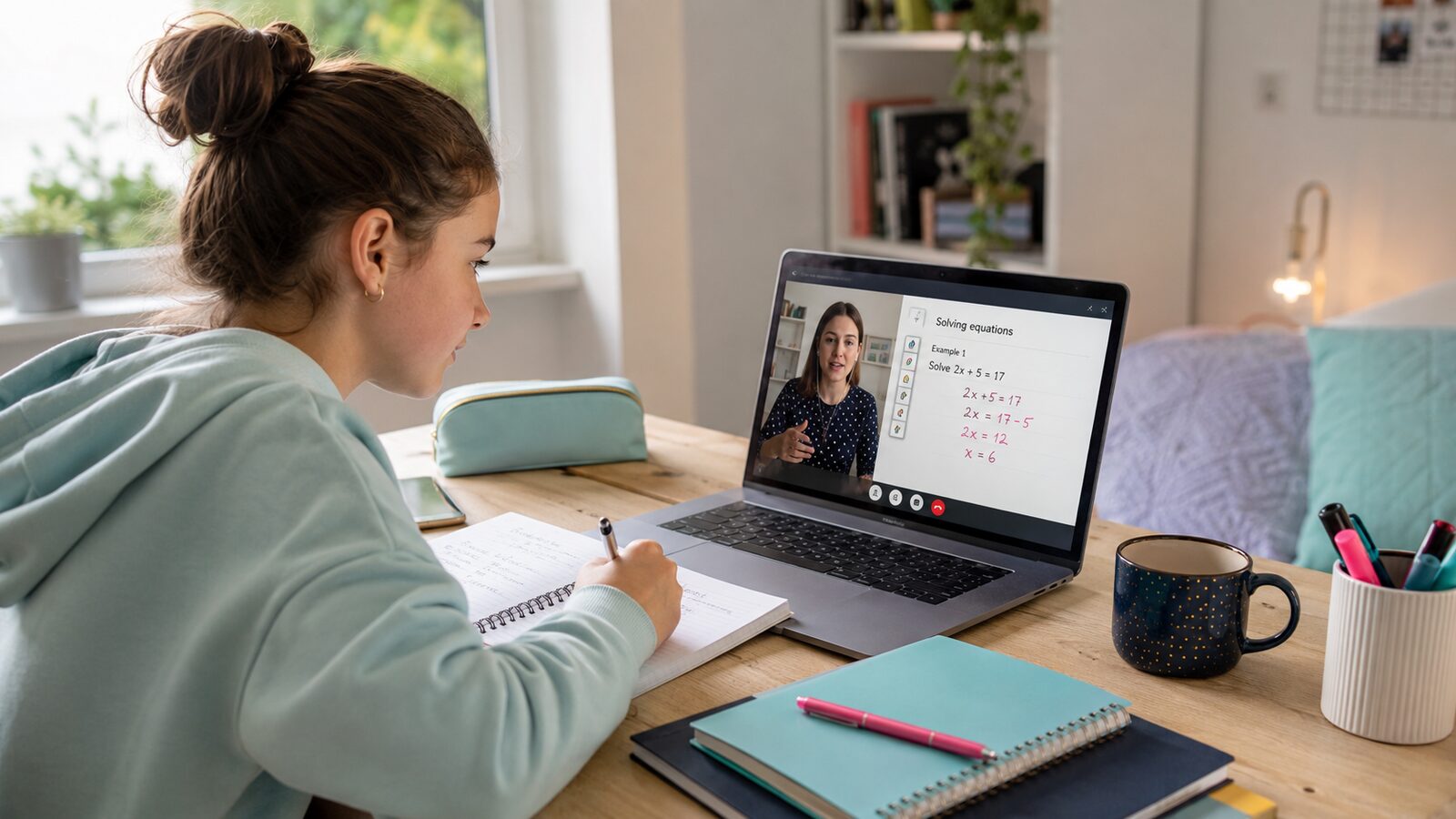
Deciding whether to introduce tutoring is not always straightforward. Sometimes the need seems obvious because a learner is finding a particular subject difficult or preparing for an important examination. At other times, the signs are much less clear. A child may be achieving reasonable grades but losing confidence, struggling to apply what they know or becoming increasingly frustrated with homework. Parents can find themselves wondering whether tutoring would genuinely help or simply add another commitment to an already busy week.
Online tutoring adds another question. Even if one-to-one support sounds useful, will it work through a screen? Will a child stay engaged? Can a tutor really get to know a learner properly without sitting in the same room? For many learners the answer is yes, but online tutoring is not automatically the right choice for every child or every situation. Its value comes from the quality of the relationship, how well support is personalised and whether there is a clear reason for introducing tutoring in the first place.
Start with the problem you are actually trying to solve
Before choosing a tutor, it helps to be clear about what you hope tutoring will change. A learner who finds fractions difficult needs something different from a student who understands the content but struggles with examination questions. A child who has begun saying they are “bad at Maths” may need academic support alongside opportunities to rebuild confidence, while another learner may simply need greater challenge because classroom work is no longer stretching them.
Parents sometimes begin by asking how many tutoring sessions a child needs, when the more useful first question is what is actually getting in the way. There may be a knowledge gap, difficulty applying knowledge, weak examination technique, low confidence, organisation problems or a combination of several factors. That distinction matters because additional teaching is only useful when it addresses the real need. More worksheets will not solve poor examination technique, and repeated examination practice will not help much if the underlying subject knowledge is insecure.
One-to-one support can reveal things that are difficult to see in a classroom
A busy classroom has to work for many learners at once. Even excellent teachers cannot always stop a lesson to explore why one particular student has misunderstood a concept or why another appears to understand something verbally but cannot demonstrate it on paper. One-to-one tutoring creates more space to investigate those differences.
A tutor can ask a learner to explain their thinking, notice where a method begins to break down and adjust an explanation immediately. They can spend longer on something that needs more attention or move more quickly when the learner has already understood it. Over time, patterns can become clearer. A student who appears to struggle with algebra, for example, may actually have an earlier difficulty with negative numbers or manipulating fractions.
That ability to respond in real time is one of the main reasons one-to-one tutoring can be effective. The value is not simply that there is only one learner present. It is that the session can change according to what that learner needs. If you would like a deeper explanation of what this means in practice, our guide to what personalised tutoring actually means explores that in more detail.
Online tutoring can work particularly well for learners who prefer a familiar environment
Some children are noticeably more comfortable learning at home. Removing the journey to a tutoring centre, the unfamiliar room and the presence of other students can make it easier for them to focus on the learning itself. For a learner who finds busy environments tiring or distracting, joining a session from a familiar space can reduce some of the additional demands surrounding learning.
That can be particularly helpful for some children who learn differently, although there is no single approach that works for every child who learns differently. One learner may benefit from clear routines and advance notice of what a session will involve, while another may need movement, visual support, more processing time or shorter tasks. What matters is the tutor’s willingness to adapt rather than assuming that a particular label automatically determines how someone should be taught.
Online support can also suit families who travel, live internationally or simply need more flexibility around school, work and other commitments. The learner can continue working with the same tutor even when location changes, which can provide useful continuity.
But the screen itself is not what makes tutoring effective
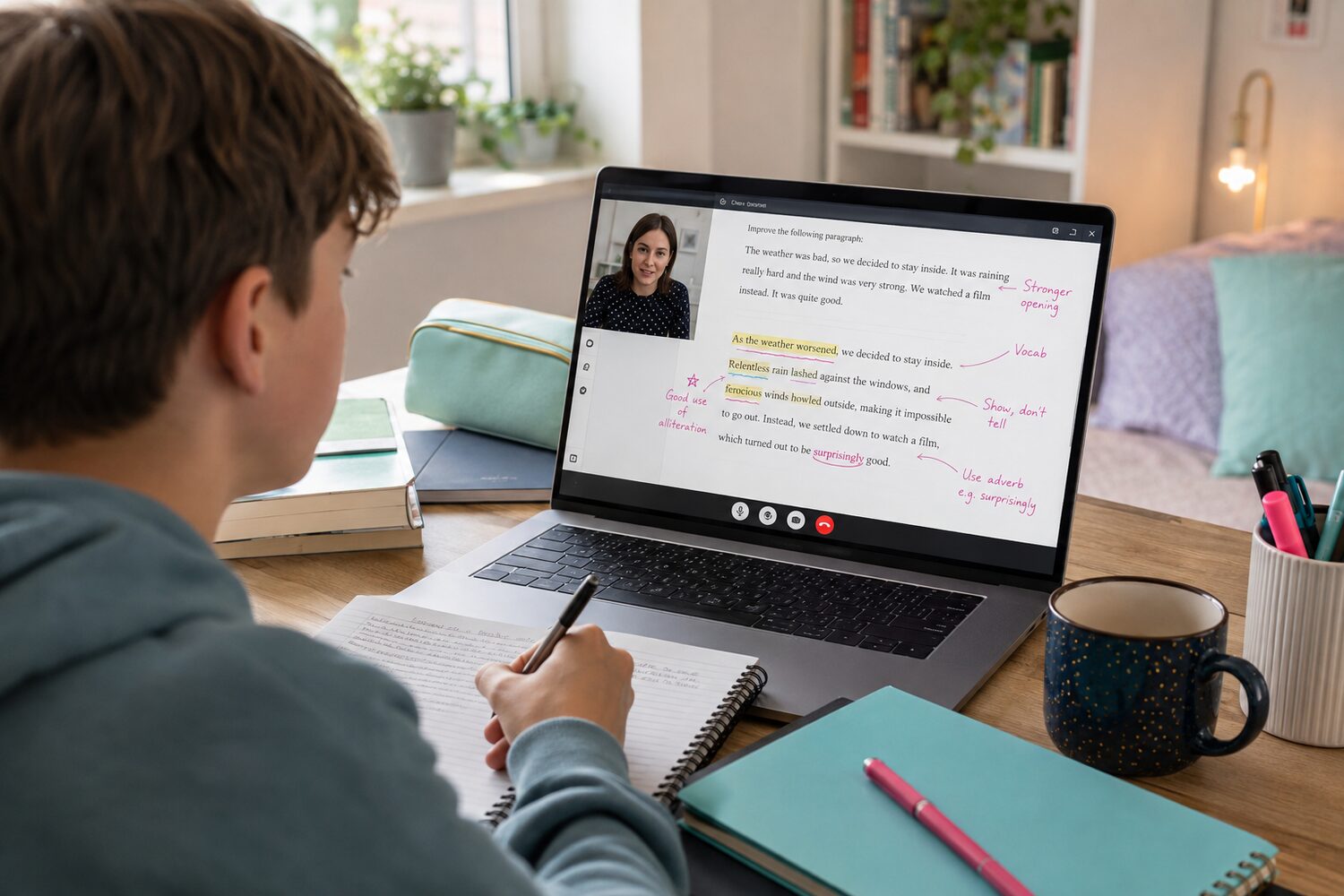
Parents sometimes worry that online tutoring will mean a child passively watching someone explain work for an hour. It should not. A good online session can involve shared documents, interactive whiteboards, diagrams, worked examples, discussion, games, examination practice and resources that both tutor and learner can use together. The learner should be thinking, explaining, applying or creating rather than simply listening.
The technology is therefore a tool rather than the teaching method. A weak tutoring session does not become personalised simply because it happens one-to-one on Google Meet, just as an excellent tutor does not become ineffective because they are teaching online. What matters is how the session is planned, how actively the learner is involved and how responsive the tutor is when something is not working.
Confidence can be part of the academic picture
A learner does not need to be significantly struggling before tutoring becomes worthwhile. Sometimes the first noticeable change is confidence. A child may stop putting their hand up because they are worried about being wrong, avoid homework, rush through difficult questions or say “I don’t know” before they have really considered the problem. An older learner may understand a topic in class but become convinced that they cannot do it when they see an examination paper.
In situations like these, confidence and subject knowledge can become closely connected. The learner may genuinely have gaps that need attention, but repeated difficulty can also change how willing they are to attempt something unfamiliar. One-to-one tutoring gives learners space to make mistakes without comparing themselves with everyone else in a class and allows a tutor to show them, through their own work, what is becoming more secure.
Confidence should not replace academic rigour. The aim is not to make every task easy or praise every answer regardless of quality. It is to create an environment where the learner can attempt appropriately challenging work without assuming that a mistake proves they are incapable.
There are situations where tutoring may not be the right first step
Tutoring is not automatically the answer whenever a child is finding education difficult. A learner who is exhausted, experiencing significant anxiety or dealing with wider wellbeing difficulties may need something other than additional academic support first. If schoolwork has become a source of substantial distress, adding another scheduled session can sometimes increase the pressure rather than reduce it.
There are also situations where a child simply does not need tutoring. They may be progressing well, enjoying the subject and managing independently. Occasionally, the most useful support is short term, perhaps help with one topic, focused examination preparation or an assessment to understand a particular difficulty. Weekly tutoring for an indefinite period should not be the automatic recommendation.
The question should always be whether tutoring has a clear purpose and whether it is likely to make learning more manageable or effective for that particular learner.
What should you look for when choosing an online tutor?
Qualifications and subject knowledge can matter, particularly when a learner is preparing for a specific GCSE, IGCSE or A Level specification, but they are only part of the picture. A strong tutor does not necessarily need to have trained as a classroom teacher to provide effective one-to-one support. What matters is secure subject knowledge, the ability to explain ideas clearly, relevant experience and an understanding of the learner’s course or examination requirements where appropriate.
Rapport matters too. One-to-one tutoring depends heavily on the relationship between tutor and learner because students are far more likely to ask questions, admit when they are unsure and persist with difficult work when they feel comfortable with the person supporting them. Patience, communication, reliability and the ability to build trust can therefore be just as important as formal teaching credentials.
Parents should look at the tutor as a whole. That means considering subject expertise, relevant experience, safeguarding, communication and how well the tutor connects with the learner rather than relying on one qualification as the sole measure of quality.
It is also worth asking how the tutor establishes a learner’s starting point and how sessions will adapt over time. A good tutor should be interested in what the student already knows rather than simply starting at the beginning of a standard programme.
How quickly should you expect to see a difference?
There is no responsible answer that applies to every learner. Sometimes a student experiences an immediate improvement because one misunderstanding is identified and explained differently. In other cases, progress is gradual because earlier knowledge needs rebuilding or because confidence has been affected over a long period.
Examination students may also need time to turn knowledge into better performance. Understanding a topic is not the same as being able to apply it accurately under timed conditions, and examination technique develops through deliberate practice. Our guide to helping a learner build exam confidence looks more closely at preparation, past papers and managing the demands of examinations.
This is why tutoring should not be sold as a quick fix or a guarantee of a particular grade. A better measure is whether the learner is gradually becoming more secure, more independent and more able to explain what they are doing. Progress might show up as attempting questions they previously avoided, making fewer recurring mistakes, revising more effectively or becoming more willing to ask for clarification.
What does useful support look like between sessions?
The live session is only one part of the wider learning process. Depending on the learner, useful support between sessions might include a small amount of targeted practice, revision resources, marked work or recommendations about what to revisit independently. The amount should reflect the learner’s age, goals and existing workload rather than automatically creating more homework.
Organisation matters too. When resources, feedback and previous work are easy to find, learners can revisit what they have covered rather than treating every tutoring session as something completely separate from the next. At Plan For Success, ongoing learners use Google Classroom as an organised space for relevant resources, work and communication, which can be particularly useful when tutoring sits alongside school, home education or an international curriculum.
The aim is not to fill every available hour with academic work. It is to make the time spent learning more purposeful.
How can you tell whether online tutoring is right for your child?
There is rarely one decisive sign. Online tutoring may be worth exploring if your child needs more individual explanation than they currently receive, has gaps that are beginning to affect later topics, would benefit from targeted examination preparation or is losing confidence despite having underlying ability. It can also be valuable when a learner needs greater challenge, when parents want specialist subject input or when a family requires consistent educational support that is not tied to one location.
Equally, it is reasonable to decide that tutoring is not currently needed. A good tutoring provider should be comfortable with that possibility. The purpose of an initial conversation should be to understand the learner and decide what kind of support, if any, would be useful rather than to persuade every family into the same service.
If you are still uncertain, think about the change you would most like to see. Is it stronger subject knowledge, better examination technique, greater confidence, more independence or a clearer routine? Once that is understood, it becomes much easier to judge whether tutoring is the right way to achieve it.
Final thoughts
Online tutoring can be an effective form of educational support, but its success does not come from putting a learner in front of a laptop. It comes from the same things that make good one-to-one teaching effective anywhere: understanding the learner’s starting point, adapting explanations, providing appropriate challenge, building a strong working relationship and having a clear purpose for the support.
For some learners, the benefits are largely academic. For others, the most important early change is that learning begins to feel more manageable. Many will need a combination of the two. The better starting question is therefore not simply “Does online tutoring work?” but “What does my child need, and could personalised one-to-one support help with that?”